How to write a signal-based copy that converts in 2026
Insights from vetted experts and our own approach to booking calls with CEOs with 8 to 10 digits in revenue.

Before you read this
This is the practical companion to our previous playbook, Most list-building advice is built for one motion. Yours has two. That one shows you how to structure the engine: your evergreen layer, your custom layer, the post/intent layer, and how they stack. If you haven't read it, start there, because this guide assumes the engine already exists.
This guide is about the part most teams skip: the copy that sits on top of the signal.
After 700+ demos with Signalbase, my takeaway is simple: most signal-based engines fail because the copy is generic at the exact moment it needs to be specific. You can have perfect signal infrastructure and still get zero replies if your first line could have been sent to anyone.
This isn't for beginners. If you've been in GTM for a few years, you've likely done some version of list → blast → silence. This guide is the intervention.
The thesis: Signals are the foundation, copy is the multiplier
Here's what almost nobody has internalized.
A signal gets you the pass to knock on the door of the right account, the right person, but only in the right moment.
That part is non-negotiable, and getting it fast, fresh, and verified is a real edge: a signal you act on in the first hour beats the same signal a day late, and a signal you can trust beats a guess every time. None of what follows works without that foundation.
But the foundation alone doesn't close anything.
Once you're in the room, what you say is the multiplier, and it's the part most teams skip.
"It's noisy because everybody else is hitting them with lower-quality messaging than you would like. That doesn't change the fact that it's useful. It just means it's noisier, harder to get through."
The signal itself is always valuable, but if you treat it as your silver bullet you will lose as you skip mapping out the bigger picture.
Funny enough, this is where a lot of SDRs also lose their grammar as they simply won't know what to write about, and this is why you need to either wait a bit more for the next signal which you can put inside the copy or work with historical signals.
Those are two different problems, and the entire industry is misdiagnosing the second one as the first: blaming the signal for what is really a messaging failure.
If you want this in numbers: André, a revenue leader who's run go-to-market in-house and fractionally across companies up to €35M, told me the blasted-AI-email channel now returns 0.5% to 1% reply rates, in contrast to the 15% hit rate when there is the same outbound around scraped, account-specific context with the right signal.
Part 1: The distinction that fixes everything, relevance ≠ personalization
If you take one idea from this entire guide, take this one.
It came up in almost every episode of the podcast, unprompted, from people who'd never spoken to each other.
Personalization is "I saw something about you." Relevance is "I understand your situation."
They are not the same thing, and confusing them is the single most common reason experienced operators still get ignored.
Personalization such as "I noticed you went to Manipal University, how was the lake?" as an opener does not work anymore, and neither does generic copy like "I saw you liked mountain biking."
Relevance simply should matter even if the signal you're talking about isn't there. Now sit with that for a bit!
- If your message only works because you mention the trigger like "congrats on the raise," "saw you're hiring," and collapses into nothing the moment you delete that line, you were personalizing without being relevant.
- If the message however would still land on the right person even with the signal stripped out, you've got real relevance.
Vaibhav from Smartlead compressed the whole principle into one line I keep coming back to: "The signal is the trigger. The profile is the sale."
The signal tells you when and who. It is not the message. The message comes from understanding the world that the signal just revealed.
And here's the warning Mitchell added, the one that should make you uncomfortable if you've been leaning on a tool to do the thinking for you:
"Without good messaging, signals are something to hide behind."
Ilija Stojkovski from HeyReach, who has watched this fail across thousands of agency campaigns, puts the positive version as bluntly as it can be put:
"Hyper-relevance beats hyper-personalization. A hyper-relevant audience can take the most generic message in the world, as long as it's congruent to the problem, and it'll be your best campaign."
That's the permission slip to stop agonizing over clever personalization and start obsessing over whether you're talking to the right person about the right problem. Get the relevance right and the copy can be plain. Get the relevance wrong and no amount of clever will save it.
Every signal comes with a source, right? Make sure to give it as a contextual piece to your LLM / SDR to learn from before writing the message.
Part 2: Signal vs. intent (because most people blur them)
Before we get to writing, one distinction matters because blurring it leads to creepy, mistimed outreach:
- A signal is external context. Something happening in the outside world that your team uses to stand out (funding, a new hire, an acquisition, who someone follows, a new certification).
- Intent is internal movement. Activity on your own digital presence that shows someone is actively engaging with you (visiting your pricing page, hitting your API docs, booking a demo, talking to support, returning to the site).
Signal is third-party and tells you who and roughly when. Intent is first-party and tells you they're actually moving.
The best teardown of this I have is Liam Moroney buying SparkToro, which played out publicly.
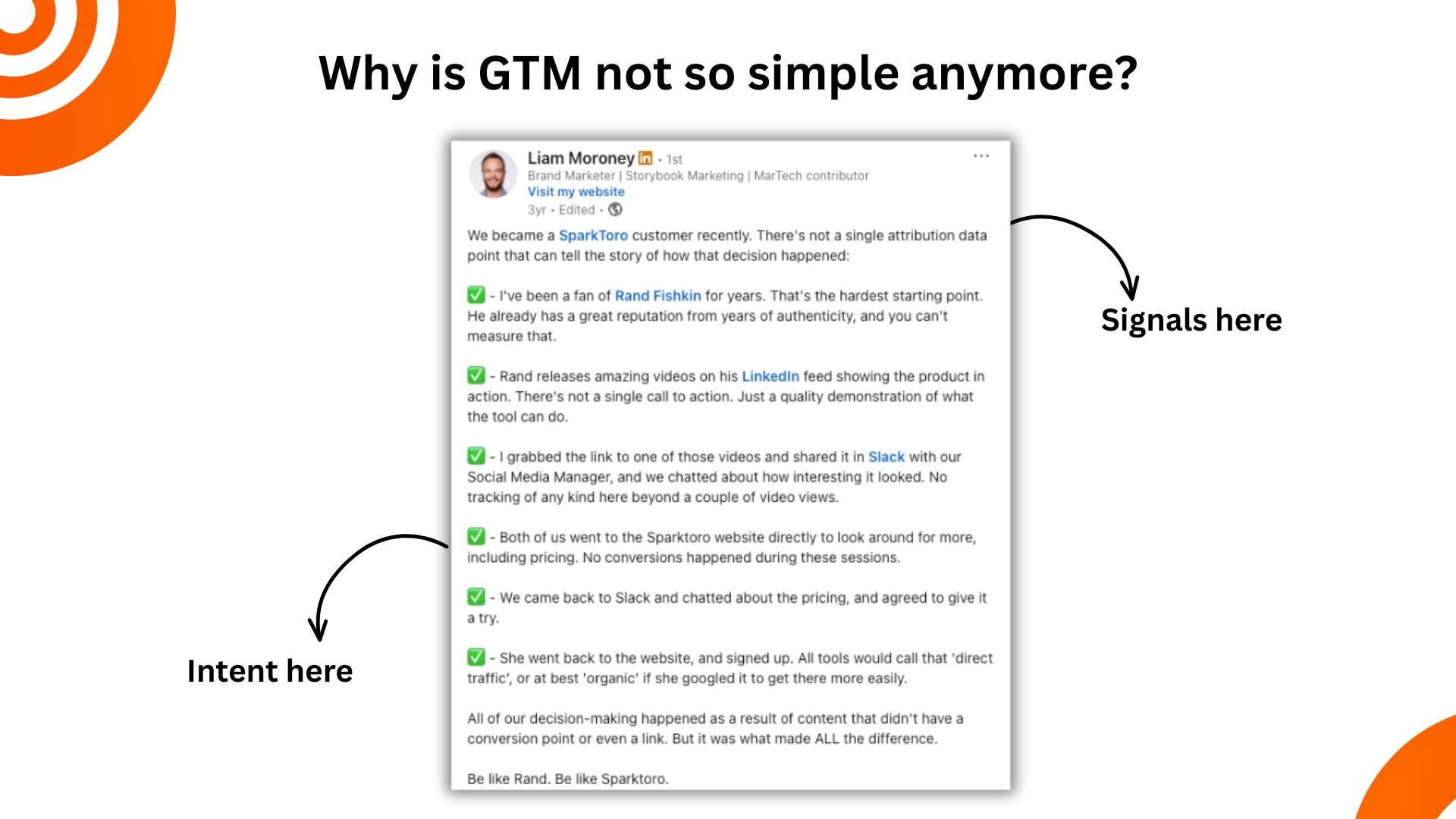
Trace it:
- Liam had followed Rand Fishkin for years. That's a signal, pure context. It tells you his interests, makes him a great person to put on a list. It is absolutely not a buying signal. If you'd messaged "saw you follow Rand!" you'd have been the creep.
- Then he visits the SparkToro pricing page. Now we have intent: first-party movement on their own property.
- He goes to Slack to discuss the pricing. Invisible to the vendor. You can't track that, and that's fine.
- He returns to the site. Intent picks back up.
The signal (following Rand) was the permission to be on the radar. The intent (pricing page, twice) was the movement that said now. One built the relevant audience; the other revealed the timing.
Lose that distinction and you'll either message a "signal" as if it were buying intent (creepy, premature) or sit on real intent waiting for a "signal" that already happened.
This is why a campaign built on engagement alone underperforms: a like or a lead-magnet comment is neither a strong signal nor real intent.
Most people won't agree, but even if your champion wants to buy your services or product, if there is no budget in place, there won't be a sale.
Part 3: Name the consequence, never the signal
This is the technical heart of the guide.
Once you accept that the signal isn't the message, the question becomes: what is the message?
Teardown 1: Landing a job offer (same mechanic)
Before becoming a mentor at the Clay Bootcamp, Tanay applied to ~50 customer support roles and got radio silence. Then he asked: why would a company hire support?
So he looked for the breakage: unanswered public reviews, ignored G2 threads, customer questions piling up in public Slack communities. He found a company with unanswered questions, messaged the CEO ("looks like people are going unanswered"), and had an offer in days.
He never said: "I saw you're hiring."
He named the consequence of the gap.
Teardown 2: Gap-spotting, the signal is the absence (Wesley Hoang)
Sometimes the best signal is what's missing:
- no in-house CFO
- no RevOps function
- no outbound motion
- no implementation lead
Absence doesn't "fire" a typical alert, so competitors miss it. One clean application: when an exec leaves, don't only chase them to the new company. Target the company they left. There's a hole now. Offer a bridge ("fill the gap temporarily / save the hire / do it cheaper").
Note: a job change creates two plays:
- company they left = gap play
- company they joined = champion/relationship play
Same event, opposite direction.
Teardown 3: Look ahead, not behind (Olivier, Outbound Catalyst)
Don't reference the past. Predict what's next.
Example: "I saw you've had three salespeople in and out in 18 months. Sounds like the issue isn't 'finding reps' but the lack of a repeatable playbook. Is the bottleneck messaging, prospecting, or onboarding?"
He doesn't congratulate or "fact-dump." He reads a pattern, names the likely cause, and asks a question that forces a real answer.
Teardown 4: A tiny detail that proves attention (my own)
Here's the full version of the story, because it shows the whole method end-to-end.
A vendor I'd been watching rebranded and started moving toward building signals, which is one of my own custom signals (it's the moment they're likely to feel the pain of building signal infrastructure).
I also had context most people would ignore:
- I knew their previous Head of Marketing (they'd left).
- I knew their previous CPO (they'd left).
- There'd been acquisition noise that didn't work out, and it looked like they were changing route.
Then I noticed a tiny detail that confirmed "new chapter": the CEO's profile branding shifted (they rebranded from blue to green). Around the same time, their CTO and CMO started posting more about going in a signal-led direction.
So I shot my shot to the CEO. I didn't open with "congrats on the rebrand" or "saw you're moving into signals." I used a light, human opener that proved real attention:
- "Green suits you better than blue."
Then I followed with one tight line that proved I understood the directional change and what it implies (building signal infrastructure is heavy), plus a single anchor.
And in the P.S., I added another small, real detail: I noticed the CEO was an Inter Milan fan, so I referenced their win streak at the time.
Result: I booked a call with the CTO ~6 months before their actual buying window.
Part 4: Building the message, from signal selection to the sentence
This is the longest part because it's where most deals are won or lost. It has two stages: first select the signals and boil them down to one insight, then write the sentence. Skip either and the message falls apart.
Stage 1: Select the signals, then cut them to one insight
Three steps, in order:
Funding, a tech-stack change, hiring, market expansion, or a job change. This tells you the account has money moving and is worth your time.
The one that says this account needs me now. Name the single moment your product becomes relevant, then work backwards to the observable thing that precedes it. Most people never build this layer.
What they're reacting to, what they're posting about, where they're showing up.
Merge all three into one rock-solid message that stands out.
One last thing before you write. You gathered the signals to understand the account, not to recite them back.
Stage 2: Write the sentence
You've got your signals and boiled them down to one insight. Now the copy itself.
The bar every message has to clear: too good to ignore. Pawel Nical gave the masterclass example, and it's the one to hold in your head as the standard.
He worked with a company doing digital headhunting for hard-to-fill roles, sourcing CNC operators for manufacturing production lines.
A hiring signal for a CNC operator is not the same as one for a web developer, because if a CNC role sits unfilled, the production line stops. That's not an inconvenience; it's revenue bleeding out by the day.
So the copy didn't say "I see you're hiring a CNC operator." It led with relevance + urgency + the specific pain:
"Your opening's been live for 30 days, we filled an identical role for a similar company in two weeks, and every day this seat is empty your line runs under capacity."
That's the bar. Relevance + urgency + specific pain = too good to ignore. Relevance but no urgency is a "nice to know." Urgency but no specific pain is a generic fire alarm. You need all three.
The mechanics: Mitchell's value equation.
Underneath every message that works is the same equation you're trying to maximize:
(Dream outcome × perceived likelihood of achievement) ÷ (time delay × effort and sacrifice)
Most people raise perceived likelihood with social proof, with stuff like case studies, logos, "we did this for 12 other companies." Mitchell's contrarian and correct point: that's weak at the top of the funnel, because trust is at an all-time low and a case study reads as a buying prompt rather than a believe-me prompt.
"A case study is buying-type social proof. At the top of funnel you want belief-type social proof: why you should believe I can do it, not why you should buy from me."
Instead, he raises perceived likelihood through worldview framing and attaching the outcome to something the prospect already understands about their own business:
Teardown 5: The Canadian tax-loophole CFO message
Targeting mid-market CFOs.
The signal: the company has five developers based in Canada. Boring, firmographic, worthless on its own.
"I was going through your team and I see five developers based in Canada. Based on average salaries, I'd imagine you're spending around [X]. What we found is [specific thing in the Canadian tax code], it could save you close to a million this year based on what I'm seeing. Worth discussing?"
Zero social proof. No case studies. It raises perceived likelihood purely by demonstrating he understands the CFO's day-to-day.
Teardown 6: The connection request formula that booked me calls with CEOs with 8 to 10 digits in revenue
In order:
Not a claim, a question they can't disagree with about their own operation. "Still trying to crack the SEO nut in [new market]?" This is where the signal lives, encoded rather than stated.
How others in their exact situation struggle, and where they tend to mess it up. Your relevance proof. It signals you've seen this movie before.
How you solve exactly that, with what makes you different at the end.
One thing: a competitor you work with, a concrete outcome, or a person you've already spoken to. One. Not a wall of logos.
Nowhere in that structure do you write "I saw you raised" or "I noticed you're hiring." The signal is the reason you're writing. It is not a line in the message.
The negative-question variant (my booked-60-demos formula). A twist on the opener that has worked better than almost anything else for me. Instead of a neutral implicating question, open with a negative one: "Is it a bad time to help you with [specific problem]?"
Why negative? People are wired to protect themselves. So much is sold to them that their reflex is to say no.
Give them a "no" that means "yes." "Is it a bad time?" → "No, it's not." You've made it easy and almost satisfying to correct you, and a correction is a conversation. Say something slightly wrong on purpose and people jump in to set you right, revealing things they'd never have volunteered to a pitch. Two more things that keep it human: a genuine P.S. (reads personal, not templated), and, counterintuitively, leaving in the occasional natural typo. Polished-to-perfection reads as AI now; a little texture reads as a person who actually typed it.
Part 5: A bad example, in the wild
Here's a bad example of signal-based GTM. By now you should be able to autopsy it yourself, but just in case, I'll walk it.
I got another "signal-based" message that makes you wonder when the industry will admit it has a problem nobody's talking about. The sender bought a tool that lets him reach out the moment a prospect engages with a post. The signal fired. Then he had to write the copy. Here's what landed (lightly trimmed):
"Appreciate the connect. Your thoughts on context engineering and signal quality really resonated. I noticed you're exploring how AI can power better outbound, and [Tool] helps turn those signals into actual campaigns. Open to a quick look at the 14-day trial?"
What went through my head reading it: What about my post? Why did it resonate? Why am I getting this? Written like that, there's no way he actually caught and read a signal. Slop.
Four things went wrong:
"I noticed you're exploring AI outbound" → "our tool does that" → "want the trial?" Zero insight in the gap where the whole message was supposed to live.
Strip the signal line out and nothing remains. The strip test fails instantly.
So the copy went lazy.
A tool that turns signals into campaigns sent a campaign that whiffed, on the person who builds the signal layer.
The post I engaged with pinged 40 other tools the same morning. We all got the same "really resonated" opener before lunch. You already know the fix from Part 4: bake the context around the signal into the message, and write the state it puts them in. Never the event.
The 60-second version (steal this for Monday)
If you read nothing else:
- The signal is the foundation; the copy is the multiplier. A fast, fresh, verified signal gets you the moment. Then the copy decides whether it converts. Most teams nail the first and waste the second.
- Relevance ≠ personalization. The test: delete every line that states a fact about their company. If the message still proves you understand their situation, you nailed it. If it collapses into generic, you were naming the signal instead of using it.
- Name the consequence, never the event. Don't write "you raised." Write what's now true or at risk because you did.
- Clear the bar: relevance + urgency + specific pain = too good to ignore.
- Raise perceived likelihood with worldview framing, not case studies. Prove you understand their day-to-day.
- Match the motion to the ACV. Broad + educational for low ACV. Deep + research-heavy for high ACV. Don't mix them up.
- Stack signals for depth, but don't over-target a 100-person segment when a broader one makes more money.
- Curate context ruthlessly. One sharp insight beats five crammed-in facts.
- Validate manually first, then engineer the repeatability. Across every operator I've interviewed, nobody defined this work by their tool stack. They proved the play by hand, found where it broke, then automated it.
The signal got you the data. Your copy decides if it converts.
Closing notes
Signals are one of the most powerful tools within modern-day GTM, but without a proper copy nothing will close.
A signal only earns you attention. The conversion happens in the next 4 to 6 lines, when you prove you understand their situation without reciting the trigger.
Before you hit send, run this filter:
- If I delete the trigger line, does the message still work? (relevance > personalization)
- Am I writing the event, or the consequence? (state > headline)
- Is there a real tension here: urgency + specific pain? (too good to ignore)
Now do the reps: pick 10 accounts, choose 1 or 2 signals each, and write 10 messages where the signal stays unstated and the consequence does the work. Measure meetings booked, never reply-rate vanity.
If you want to see what this looks like with source-backed signals (so you can spend time writing instead of hunting), try Signalbase or book a brainstorming session and we'll outline the motion and write the first messages together.
Chat later,
Georgi
Spend your time writing, not hunting
Copywriting becomes easy when you know the full story. Get source-attributed signals at scale.
More research
The 3-layer engine this guide sits on top of: Discovery → Interaction → Proof.
474 funded startups, a 35-day median to the first hire, and why the round opens a watching window.
How marketing and GTM Engineering use the same word for two different stacks.